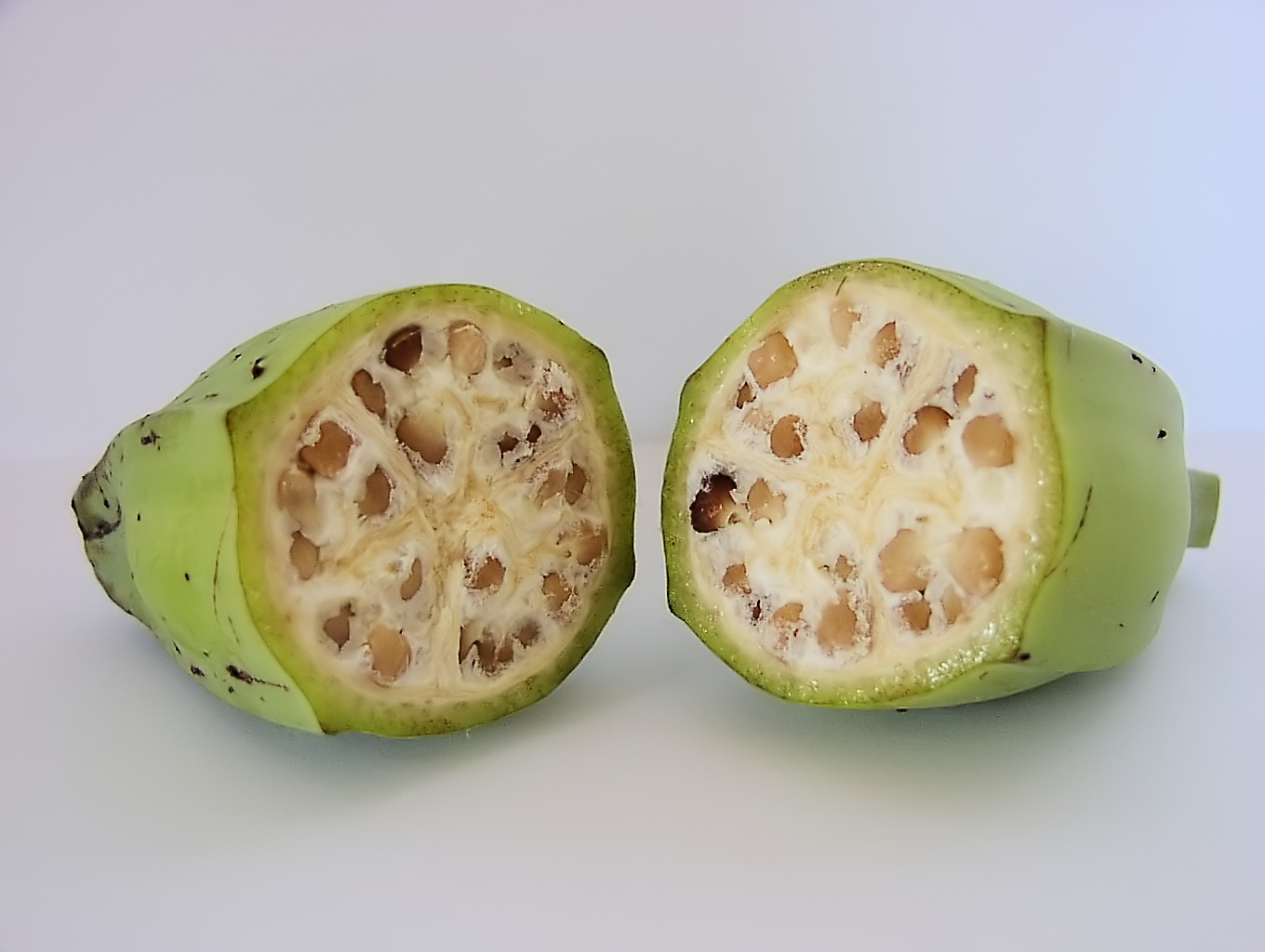
Did you know? The banana we normally eat are sterile and have no seeds. There are approximately a thousand species of bananas, most inedible. Botonists hypothesize that about 10,000 years ago, probably in South-East Asia, some random mutation gave rise to a sterile banana with no seeds and plump flesh that could be eaten raw.
Wild bananas.

The sterile banana plants grown in plantations are reproduced by cuttings from an existing banana plant. The life cycle starts with a large underground stem that can bud several banana plants. Each bud pushes up a shoot of leaves, tightly wrapped so that it looks like a green tree trunk; however, the banana plant is technically not a tree. At a certain time, the underground stem will switch from making leaves to an inflorescence, which is a cluster of flowers. Flowers become fruits and we get a hand of bananas. So each underground stem produces several banana plants, which in turn produces several hands of 10-20 bananas each. After fruiting, that bud and plant will die, and the cycle continues the next summer, when new buds appear on the underground stem once more.
Since the edible banana species are reproduced by cuttings, i.e. asexually, there is little or no genetic variation, and a disease or lethal mutation could potentially wipe out the entire crop.
Another bit of information: the edible bananas we are familiar with arise because of a trisomy. What does this mean? Most organisms have two sets of chromosomes (one from each parent). Monosomy occurs if a chromosome is missing, and a trisomy refers to the presence of three sets of chromosomes. For instance, the presence of an extra chromosome 21, which results in Down syndrome, is called trisomy 21. When an organism is a trisomy, it also becomes sterile, and in the case of a fruit like a banana, it will not produce seeds. Incidentally, this is also how seedless grapes come about.
The take-home message: even though the banana is rather phallic in shape, it is actually a sterile and mutant fruit that has not had sex in the past 10,000 years.


No comments:
Post a Comment