Saturday, May 24, 2008

ReNe: accidental social microcosm

There was an interesting article in NYTimes today about blogs and the over-exposure of one's personal life [1]. Well, interesting in a few ways. The article itself, while rather self-absorbed, was also well-written and pulls you along for all ten pages. Then, there are the hundreds of comments, the majority scathing. That's pretty amazing and kinda sad.

However, the article and comments raises an interesting point -- that of over-exposure and over-sharing. How much (personal) information is too much? I've thought about this too, when we started this blog. In fact, I was highly wary putting up personal photos for a while at first.

Years back, there would be loads of horror stories over some abuse of personal information and especially personal photos posted on the web. I wouldn't have dared blog. Surf as an anonymous user, yes; identify myself, no. Now, there are still horror stories, but our attitudes seem to have evolved, and we now see it as an acceptable risk. It's like many new technologies -- when the car or airplane was first introduced, I'm sure people must have clucked their tongues over the accidents and declared that the best thing to do was not to ride the car or airplane. Avoid all new things like the plague!

But like it or not, these technologies, whether cars or the internet, are here to stay. These days, there are a lot more car accidents (because there are a lot more cars) but I can't imagine people saying that we should all avoid cars (and roads); instead, we see cars accidents as acceptable and unavoidable risks, and instead focus on how to mitigate those risks. Likewise, I think the internet has reached a stage where it's here to stay and it's definitely going to change our lives. So rather than hiding our heads in the sand and thinking that the internet is a scary place (I wonder if people would rush to take down their blogs, facebook accounts, etc. after such an article?), we should focus on how we can sensibly utilize the internet.

Interestingly, many of the negative comments on that article seem to come from the older folks, sneering at the young ones for wasting, nay ruining, their lives in front of the computer screen; basically, they told the writer to "get a life". Some of the younger readers say, "This IS our life; this is our generation." Speaking as someone who spends more time online than asleep, I am of the opinion that an online life these days can be as rich as so-called 'real life', or RL.

Blogs are controversial, because they are highly personal and because they are used for a wide variety of purposes, from writing about serious to the terribly inane. Blogs started small but somehow along the way, they've exceeded people's initial expectations. Unexpected connections and trends emerge. The blogosphere is an accidental social microcosm. People might argue that while blogs represent a new means of transmitting information, social etiquette still applies. I generally agree with that; however, where this boundary between interesting and 'TMI' occurs is highly debatable -- I wouldn't write about most of what the writer of the article blogged about, such as her urinary tract infections, but I'm not saying that she shouldn't because that's her prerogative. But this boundary between what's acceptable and what's not is vague and controversial, and continues to be redefined.

My own experience and opinion of blogging has changed over the past few months; I started tentative and bland, almost like a generic form letter or holiday card sent out to friends saying, "All is well", but lately I am thinking that our blog has more potential than that. Why do people blog; what do they hope to achieve? And do they get it? Do their blogs change; do they change? Blogging is a fascinating social phenomenon, and rather than staying at the sidelines and shaking one's head like the commentors in the NYT article, maybe one should just jump right into this virtual world.

And my main point to all this rambling? The article raises again the oft-discussed issue of over-sharing on blogs, but I ask, is it possible to delineate a threshold beyond which it would considered TMI? Given that these boundaries keep shifting with time (what would not have been acceptable ten years ago would be more acceptable now), virtual location (a candid discussion on urinary tract infections might be considered distasteful for a personal blog but it would have been fine for a medical forum) and cultures (some cultures are more liberal, others highly conservative), defining such boundaries is not easy or trivial at all.

[1] Gould E, Exposed, NY Times, 25 May 2008.

Wednesday, May 21, 2008

ReNe: stud-finder

We went to a house-warming today. At some point in the evening, Mike found a small instruction booklet for a stud-finder, and asked, "What's this?"

The Canadians were amazed. "You mean you've never seen one of these before?"

And so, the host dug out his stud-finder for Mike to play with.

For the Singaporeans, a stud finder is a handheld device used to determine the location of framing studs used in light-frame (wood) construction after the walls have been installed. The houses in Canada tend to be made of wood, and so, if you want to hang something heavy, you would need to drill right into those studs for adequate support. Most of the interior walls are gypsum boards and a hole drilled into those boards can't hold too much weight.

I found it particularly funny because at that point, everyone was standing around in the basement, talking about their own stud-finder and differences in house architecture between various countries.

In Singapore, most people stay in flats (apartments) and those are made from concrete. Even houses are built with concrete. Mostly. Adequate support for hanging up stuff is not the problem -- an adequate drill is, especially with the newer, taller flats that have many reinforced concrete pillars. Mike knows from personal experience that most consumer-level drills are not enough for reinforced concrete; you'd need a professional grade pneumatic hammer drill for that. However, concrete is too cold for Canada's weather, and wood is a better choice for building material. The host, who was from Australia, commented that most houses there are made from bricks and a wooden house is generally considered of poorer quality.

Googling online, wood is five times more insulating than brick, and 12.5 times more than concrete. R-value is a measure of heat conductivity, and wood has an R value of 1. Brick has an R-value of 0.2, and concrete 0.08.

Thus, we learned something new tonight.

Tuesday, May 20, 2008

ReNe: rented or owned, it's still your home

Adding to Mike's comments about doing up our new place...

As rentals go, this is quite different from the rentals we've stayed in so far. Usually, tenants are discouraged from doing any sort of permanent work to the room, but looking at this place, it's obvious that more than one tenant had felt free to make changes. In addition to the previous colored walls and artwork painted directly onto the walls, there are a couple of CD holders drilled into the wall under the bed loft, and a folding table by the main door, which incidentally was installed badly. Right now, we're scratching our heads over what to do with it -- re-install or not? If not, what do we do about the holes? Patch up and paint over, or find some wall scroll to cover, and then shove a table or bookshelf against it?

I'm amazed at the artwork on the walls. I think the tall 'painting' on the stairs was done by a fairly recent tenant (I found leftover skirting board in the closet, which was obviously used to create the frame), and looking around the apartment, it just seems to exudes bohemian vibes. I don't think the last tenant was the one who painted the wall artworks because he's apparently in the computer industry, but the reason he left was to go on a long, long tour around the world. A good omen, I'd say.

And, there are the hooks. There are hooks everywhere, of all sorts. There are three generously sized hooks over the main door (we've no idea what for), singular little screws here and there (I suspect for hanging artwork, because they're at eye-level), and at least five hooks in the ceiling, and a couple more under the loft.

On one hand, we're really glad to be able to customize our living space. Having owned apartments in Singapore, we've gotten used to the luxury of being able to do anything we want without having to 'seek permission'. The past two rentals I've stayed in the past year felt extremely temporary, like hostel rooms and not like a home, so I'm really looking forward to moving to this new place.

On the other hand, we're also wary of spending too much, as this is just a rental after all. There are still many things we wish to change (leaky faucets, a fridge so old it's not frost-free), but these fall under the responsibility of the building owner.

However, there are renters who would spend a lot of their own money on permanent improvements to the rental -- I'm talking hundreds, even thousands, spent on built-in cabinetry, appliances, landscaping in the garden, and so on. Their reasoning is that if they're planning to spend years in that apartment, they wouldn't mind paying to improve their living space. Also, for some, whether it's a restriction due to limited finances or a conscious choice, they would be living in rentals all their lives. Does this mean they will never live in a beautiful home? Somebody said it aptly: rented or owned, it's still your home.

That's a really interesting way of looking at it. At the other end of the spectrum, there are renters who have literally spent years living out of suitcases and boxes, always moving, never settling.

Personally, I think that if the rent is cheap enough, you could justify channeling the 'savings' towards doing up your pad. I would spend a bit, but certainly not thousands. Plus, there are ways to make-do or decorate without spending a lot of money.

More later. We've been remiss in updating because we're fricking tired. And I still had to go to work after spending the weekend painting...


MiKE: new apartment.

So, as rene mentioned, we just signed the lease on our new apartment. It's actually an attic apartment, with probably 1.5 floor height ceiling, and 2 built in loft units, one for the bed, and on for storage. The kitchen and the bathroom is on a separate, raised level. The following pictures are the 'before' shots, before we did our painting and other minor works, like changing the orientation of the bathroom door knob so that it is not possible to lock oneself in (the previous setup had the locking button on the outside(!!)), re-installing a fold-away dining table-let, and generally tightening up loose screws and cleaning up the mess left behind by the previous tenant, who seemed to have been in a hurry, leaving for a long drawn out tour around the world of sorts. So, some of the arrangements will change after we've done our work; we'll post another one then.

Here is the view from the kitchen, which is what you encounter when you enter the apartment; looking to your left, the bed:

And to the right, the storage unit:The ladder you see is very heavy, and curiously misaligned, so that leaning the upper portion on the loft, the feet would not be the same distance away from the loft edge. And yeah. We are keeping that futon, which also doubles as a mattress, so up to 2 people can sleep in relative discomfort (heh heh). Well, don't take this as an invitation, unless you're willing to pay for the privilege.

Perhaps the most impressive part of the apartment is the skylight. We've never had one of these before, always having lived in some apartment with a concrete ceiling, and in tropical singapore, one would hardly want to have the sun come in to the building, unless one had a dichroic material, which would make it prohibitively expensive, but I digress...:

Here is a shot of the kitchen area from the middle of the living area. Isn't the skylight absolutely gorgeous? Right now, at the beginning of summer, the sun is already very bright; I went there this morning to experience a virtual greenhouse (not to mention that the thermostat had been left at 30C accidentally). I think the skylight would be very welcome in winter, letting in precious sun and heat, although I wonder what is going to happen if there is going to be severe snowfall. The skylight is actually somewhat dome shaped, but still I wonder how much snow will collect. One possible downside of this is the likely increased energy loss from the skylight, and we are paying for heat. I hope it is not too bad.

The room has been through several coats of paint. It was almost like doing an archaeological examination, seeing in some corners the older paint layers. We have seen at least white, covered by maroon, covered by blue, covered by the white wash we applied, and then the final colour we chose (which we'll reveal in a later post). On this wall you see a painting framed by skirting panels, a replica of something by Gustav Klimt according to the signature at the bottom of the frame. Near the bottom of the picture you'd see the white that we are applying over the blue:

And in the kitchen, the previous occupant, or the one previous to him, painted a mural which I suppose echoes some famous artwork, and included a checkerboard pattern in black, which took us sooo many layers to completely cover. A few significant things about this new kitchen include the mercifully white worktop; compared to the fugly speckled pattern on our current place, in which anything smaller than 5mm diameter would immediately get lost, this worktop is elegant and easy to keep clean. The counter space is also that much bigger than our current one. Certainly not as big as the kitchens that we have owned, but given how we have learnt to manage with a 1m expanse, this felt good. The counter height is also significantly reduced, so serene now should have less difficulty preparing the odd meal or snack or batch of cookies.

Another shot of the kitchen area, this time to show how dark the previous colour scheme was. It was almost as if the previous users wanted to feel like they were living in a cave; you can see how overexposed the skylight is, and yet I still remain in the shadows:

Overall, after spending about 3-4 days there (painting and cleaning up, not sleeping there yet as the mattress has been ordered, let alone arrived), we noticed a few things - being on Harbord street, and not Spadina Avenue, means that we do not hear much traffic. To top it off, we were on the north facing side of the house, which overlooks the inside, quieter part, so we do not hear traffic at all, besides the odd siren of emergency response vehicles, which one must be in a really desolate place not to hear at all. We are located atop a medical (psychiatric?) practice, and they turn on their heat during office hours. Their hot air heats our floor, made of rather thin (compared to concrete) wood, which heats our apartment; so, the apartment is rather warm even without needing to turn on our heat. That's good. At this point, I suppose many things have yet to be settled, there is some leaky plumbing, and we have not even begun to move; so the best thing to say is, stay tuned...

Friday, May 16, 2008

ReNe: the body bakery


At his 'Body Bakery', Thai artist and baker Kittiwat Unarrom sells unbelievably realistic looking sculptures made from bread. Yes, they're edible. Go read this article.

I think the movie industry should hire this guy -- bread is probably cheaper, and definitely more environmentally friendly, than using latex to made corpses and dismembered parts.

Thursday, May 15, 2008

ReNe: apartment found

We're very excited -- we're moving to a new apartment soon, within a couple of weeks.

Last I mentioned in a previous post, we had been eyeing a 14th floor unit in the apartment beside our current room, but we thought to look at one last place the next day before deciding. Well, we were utterly sold on that rental the following day. It was listed as a one-bedroom but priced as a bachelor, for its location, so we were expecting something really run-down.

We were pleasantly surprised and decided on the spot to take it.

Unlike the apartments we've been staying in, which were rooms in a big building, with shared laundry facilities and garages, this rental apartment is part of a three-storey house. There is a cafe on the ground floor, and the second floor is given over to a couple of doctors' offices, while two residential units split the third floor cum attic. Mike jokes that we got the penthouse unit. So while the actual floor space is slightly larger than a usual bachelor, perhaps closer to a junior one-bedroom, there's actually a lot more space because two lofts are built into the one and half storey height. One of the lofts is meant for sleeping, the other for storage. The other thing that we loved was the skylight in the kitchen. Plus, its location. It's just down the street from our current room, which makes moving easy (we hope), and yet although the house faces a relatively busy street, our room is very quiet and private because it faces the rear.

Overall, while the facilities (closets, sinks and such) were ordinary and old, the apartment is beautiful. Lots of character. Hope that makes up for some utility inconvenience -- as there are only two residential units in that house, that means going to the laundromat and leaving our garbage out on the street ourselves.

We signed the lease today and are looking eagerly to moving in. Pictures to follow when we do.


Wednesday, May 14, 2008

ReNe: on bottled water


"Last year 16 million gallons of oil were consumed to make plastic water bottles."
Source of advertisement: DDB
(The figure of 16 million gallons was just for plastic water bottles produced in the US, and the above advertisement was produced for Brita, a water filtration company.)
“Imagine a water bottle filled a quarter of the way up with oil. That’s about how much oil was needed to produce the bottle.”

Tuesday, May 13, 2008

ReNe: free stuff is seductive

On my way to work today, as I was waiting at the junction of St George and College streets, a guy from Starbucks offered me a free sandwich sample from a tray.

Now, companies do, from time to time, offer freebies. However, I highly suspect that this morning's freebie was in some way connected to the Tim Horton's incident last week, where an employee in a London, Ontario branch was fired for giving away a timbit (a small piece of doughnut, from the hole in a regular doughnut, costing 16 cents). She was quickly rehired within hours, but not before the incident had erupted into a PR nightmare for TH. Yesterday, the Globe and Mail did an article on the case for free, or why giving out free stuff is good for PR and customer loyalty. Many companies, including Starbucks, were quick to comment that they do allow their employees to give out the occasional freebie. Of course, coffee and snacks at Starbucks are significantly more expensive than at Tim Hortons, so the 'free sample' costs has already been worked in...

Still, though the small bit of sandwich was just so-so, it made my morning. Free stuff does that to people, even when people do know that the price of the freebie is next to nothing. It's a curious phenomenon, isn't it?

I think people have this quick internal calculator that dynamically rates the quality of the food (or drink) to the price paid for it, or at least I do. If I paid a dollar for a muffin, say, I'm expecting a certain quality of muffin. If I had paid three dollars for it, it had better be a damn fantastic muffin and very often I would be disappointed. But if I paid 50 cents for it, I would probably be satisfied with even a mediocre muffin, and if it's free...

It's not just free food giveaways. People love free stuff. Buy X and get Y free. Never mind if you actually don't need Y, it's free, isn't it? Free stuff is seductive.

When Japanese department stores first set up shop in Singapore a couple of decades back (I think Isetan was the first? Or was it Yaohan?), just like the parent stores back in Japan, these department stores started giving out free food samples in the basement supermarket. I was so impressed as a kid, but then, over the years, they stopped giving out free samples, or reduced it to a really tiny piece, barely enough for you to get a taste of the product. I thought either operating costs went up or the management has gotten more penny-pinching. Or maybe, free samples just seem much more significant and bigger when you're a kid. Most likely, I concluded later, Singaporeans must have abused this free food sampling system, something I'm not surprised by. Why do I say this?

When I visited Japan as an adult, the department stores there were giving out free food samples. And it wasn't just a tiny, barely there sample; it was a generous portion, one that I felt almost embarrassed to accept because I then felt obliged to buy their product. And it wasn't only one or two little tables in the supermarket that were giving out free stuff; there were rows of tables in the supermarket handing out free samples. Outside the supermarket area, there would be other little outlets selling everything from cooked food to packaged snacks to specialty foods, and samples galore. All over, from glitzy Tokyo mega-malls to old-fashioned stores in Tohoku to quiet departmental stores in Hokkaido to tourist souvenir shops, they were giving out free stuff.

And I stood there, stuffing my face and planning my second trip round the supermarket, thinking, "This was what I remembered as a kid. No, this is even better! Much better! Bloody Singaporeans, why couldn't they have been more gracious and not abused the freebie system such that now we hardly get free samples anymore?"

Now, I know that the cost of the free stuff has already been 'worked in', and stuff in Japan is very pricey, and I did get some odd stuff that I never used, but still, I went around Japan with a huge smile and happy feeling.

Free stuff is seductive.

Monday, May 12, 2008

ReNe: a new pan

A mundane post today because I'm quite tired at the moment. We bought a new saucepan today.

As always, easier said than done. We've been toying with the idea of getting a new one for a while as the current pan is slightly too shallow, but recently, the number of scratches has increased almost exponentially and the base is permanently stained now. Suddenly, there was a sense of urgency. And since we're buying a new pan, we don't want another teflon-coated pan, so probably a stainless steel pan. Mike wanted a cast-iron pan but I flatly refused because those things weigh a ton.

We had a look at some of the pans at Sears but while there were a couple of nice pans on offer, they were still really expensive, around $75-80. In the end, we went down to Ikea today after work, where we got a reasonable stainless steel pan for $30.

We both commented on something odd while waiting for the shuttle bus at Ikea, something we noticed the last times we were at Ikea as well -- it really feels like we're in a different country. Of course we are in a place foreign to us, but why should the strangeness strike us so starkly at that point in time, at Ikea? We were hard-pressed to explain. Perhaps it's Ikea itself -- the layout is almost the same as that of the Ikea store in Singapore, down to the location of the restaurant and kids area, but unlike the one in Singapore, this is more spacious and much, much less crowded. Even the food, and cutlery and tray and all, served at the restaurant are mostly the same, and yet there is no fighting for tables, no maître d' with a headset directing customers; in fact, the restaurant was less than a third full and it was around dinner time. Perhaps this strange juxtaposition of the familiar and strange created a sense that something was 'off', and that something is that we're in a foreign land.

So we eventually got ourselves a nifty new saucepan, and we're pretty pleased. This means no more unintended consumption of plastic (teflon).

Sunday, May 11, 2008

ReNe: waterfront trail

On the weekends, when the weather permits, we go cycling. Last Saturday, we went down south to Ontario Place, and then along the waterfront trail to the Humber Bay Bridge before turning back, a round-trip of about 22km.

Compared to Singapore, Toronto has more bike-friendly policies. There are bicycle lanes drawn on some roads, and motorists here are generally much more tolerant of cyclists; there are even explicit signs at junctions telling motorists to give way to cyclists. For many people here, the bicycle isn't just a leisure sports equipment but a commute vehicle, and there are many posts and bicycle racks along the sidewalks for cyclists to chain their bikes to. Plus, winter aside, the weather here is also cooler and more conducive to cycling than the soup that is Singapore's weather.

Despite good intentions and bike-friendly policies, the roads here suck. After a long winter, the roads are uneven, cracked and full of potholes. Moreover, cars are often parallel-parked at the curb-sides, thus reducing the number of lanes by one, and one constantly has to keep an eye out on the right for cars moving out, and on the left for cars aiming for a parking spot. At some major junctions, where TTC streetcar tracks cross, it can be especially jarring.

From the western entrance to Ontario Place. From here, we continued along the waterfront, towards the windmill.

A windmill. As there is only one, I think this is more for demonstration purposes, and does not really contribute power to the grid.

Humber Bay Bridge, which was a distance beyond the windmill.

For more pix, go here.

Saturday, May 10, 2008

ReNe: on cyclones and goverments who reject aid

NY Times had an interesting, succinct piece on cyclones today, a term for a cyclic storm system first coined by Henry Piddington in the 1840s.

Piddington was among the earliest to recognize that a cyclone wreaks most of its damage not through wind but through water, by means of the devastating wave that is known as a “storm surge.”
This distinction is vital because,

The phenomenon of the storm surge has been extensively researched since Piddington’s day, yet few public-response systems have drawn the obvious lesson. To this day, the warnings that accompany a storm’s approach typically say nothing about moving to high ground: their prescription is usually to seek shelter indoors. As a result people tend to hunker down in the strongest structure within reach — only to find themselves trapped when the surge comes sweeping through.
The main point of the article was that,

...a nation need not be wealthy or technologically advanced to be well prepared for natural disasters.

A case in point is Mauritius, a small Indian Ocean island in a zone that meteorologists call a “cyclone factory.” The islanders have evolved a sophisticated system of precautions, combining a network of cyclone shelters with education (including regular drills), a good early warning system and mandatory closings of businesses and schools when a storm threatens. It’s been a remarkable success: Cyclone Gamede of 2007, a monster of a storm that set global meteorological records for rainfall, killed only two people on the island.

--------------------

Towards the end of the article, I came across an interesting line about President Bush’s rejection of the offers of foreign aid that poured in after Hurricane Katrina. This was the first time I've heard of this, so I googled for it. It was surprisingly hard to dig up a 'proper' reference; there were mentions here and there in outraged blogs but those were like Chinese whispers. Finally, I found something that better corroborates the statement in the above article,
Just a day after Hurricane Katrina decimated the U.S. Gulf Coast, Cuba offered to send 1,586 bi-lingual Cuban doctors and 37 tons of medicines and medical equipment to the devastated areas. They could have been dispatched immediately on Cuban aircraft, at no cost to the United States. Fort Lauderdale-based Gulfstream Airways also immediately offered to fly all the doctors to the United States, free of harge, if there had been any difficulty in sending the doctors on Cuban aircraft. There was no response from Washington. According to Wayne Smith, former Chief of the U.S. Interests Section in Havana, "Given the desperate situation on the Gulf Coast, one might have expected a rapid response from Washington, especially as MEDICC (Medical Education Cooperation With Cuba), a nonprofit association based in Atlanta, described the Cuban doctors as highly trained and noted that 'Cuba's experience and expertise in disaster management is so relevant to the current crisis and its aftermath in New Orleans and the Gulf Coast.' . . . What a shame. Not even in the face of the massive human suffering caused by Hurricane Katrina could the Bush Administration put aside its knee-jerk rejection of anything coming out of Cuba."

Just last week, after Cyclone Nargis hit Myanmar, Laura Bush was all over the (US) news, "urging Myamar to accept US aid". Let me get it right: Three years ago, Hurricane Katrina hit the US and Cuba offered aid, which was rejected by the Bush administration. Now, Cyclone Nargis hit Myanmar and the US offered aid, and to-date, it is still unsure if Myanmar is accepting this aid. So if the US, faced with the same situation three years ago, could turn down Cuba's aid for 'security concerns', what moral authority do they have to lecture Myanmar for doing the same? Not that Myanmar is right for rejecting aid from the US, but the supreme irony kills me.

...(Mrs. Bush) faulted the junta for proceeding with a May 10 constitutional referendum that she described as a sham, and criticized government leaders for not warning citizens about the storm.

"We know already that they are very inept," she said.

--snip--

"I'm worried that they won't even accept U.S. aid," Mrs. Bush said. "And I urge the government to accept aid from the United States and from the entire international community right now while the needs of their people are so critical."

All I can say is, glass houses and stones.

ReNe: cheap words

On 8 May 2008, the Straits Times reported that Chan Mun Chiong was charged with committing an act of gross indecency, i.e. under Section 377A of the Penal Code.

His offence, to which he apparently intends to plead guilty, was to have oral sex with a 16-year-old boy when he knew he was HIV-positive. For that, Chan was also charged under the Infectious Diseases Act for endangering the health and the life of his partner.

However,
The Prime Minister, last October 23rd, said in Parliament that the authorities would not “proactively enforce Section 377A.” In effect, he was assuring gay citizens that they could consider Section 377A as no threat and not fear discriminatory treatment under the law.

I agree that Chan deserves to be charged under the Infectious Diseases Act, but not under Section 377A, because that is a grossly unfair and discriminatory law. Also, I wonder, how can his full name be published in the national newspaper? The case is not even closed yet! What sort of treatment is this -- guilty until proven innocent? Oh wait, it's actually, guilty even though prisoner hasn't pleaded anything and case is simply awaiting sentence.

I am not sure but I thought that generally, even charged criminals in most cases have some sort of right to privacy, so much so that some groups are pressing their government to release names of 'high-risk' criminals such as pedophiles to the public. Of course the Singapore government, and the press apparently, believe in the 'name-and-shame' tactic.

Many states have laws to protect the confidentiality of victims of crime. Most of these laws relate to specific groups of victims: sexual assault victims, domestic violence victims, abused or neglected elderly or disabled adults, missing persons, hate crime victims, and child victims.
--The National Center for Victims of Crime

However, even if there are no explicit laws prohibiting the release of the criminal's name, what about rights to the privacy of the victim? There are definitely laws protecting the victims, or there should be, so won't naming Chan put the identity of his victim at risk? Suddenly, all teenage boys he has been seen with or know are not only at risk for being outed, not only as a gay, but a victim and a potential HIV carrier as well, even if they are not the real victim.

But wait. The Singapore government, police and press apparently don't care about that, do they?

Thursday, May 8, 2008

ReNe: stand-ups

Recently, we've been watching stand-up comedies (off the net, of course, because we are cheapskates), something I've never really watched before. Mike's a fan of such shows and he was quite eager to force them down my throat.

The first comedian was Russell Peters, an Indian-Canadian who hails from Toronto; Indian as in Asian Indian and not the North American Native Indians, and a central theme through his jokes is that of race. Pretty funny and he does accents very well, but after the fourth or fifth show, some of his jokes were getting old.

Then we started watching Eddie Izzard, a British comedian who dryly refers to himself as a male lesbian. He's a bit too stocky to look good in drag, but after a while, his quirky style really grows on me. I was hooked. His jokes were more rambly, very Monty Pythonish in its randomness and brilliance, full of non sequiturs, and covers a gamut of topics from history and Europe to household appliances and miner cats and the Star Wars canteen. The British monarchy wasn't spared either.

(I really like his term, male lesbian, because I can fully empathize. I always wanted to be a guy, but then my sexual preferences also run towards those of the male persuasion; I guess this makes me a female gay!)

After that, I watched a couple more, like Lewis Black and George Carlin, both Americans, but I never managed to really get into their jokes. Maybe it's just a coincidence, but I noticed an interesting trend in the very small sample size I watched. The Canadian comedian talked a lot about racial and immigrant issues, something near and dear to Canada, and the American comedians ranted on and on about the Bush and religion, hot topics for Americans, I'm sure. I can see why -- you would want to talk about issues that would resonate and connect with your audience, which would likely lead to jokes that are country or geographically dependent. And if so, what does that say about British humor and the topics that are near and dear to them?

Wednesday, May 7, 2008

ReNe: 30km

Apparently, we are currently living 31.32km away from a nuclear power plant. The Pickering nuclear plant to be exact. Pickering is Canada's oldest nuclear power plant, and is situated 30km from downtown Toronto, closer than any other reactor to a major population center, and provides 50% of Ontario's power needs.

Scary, ain't it?

The Canadian government is considering spending billions to upgrade the reactors so as to extend their lives till 2060, but many think that the money could be better spent on greener, alternative energy resources, and I agree. For example, Denmark produces more than 20% of its energy from wind power. Though I keep complaining about how windy (and chilly) Toronto is, I'm not sure if it's as windy here as in Denmark. Still, it is one very viable alternative. In 2006, wind power accounted for 0.7% of Canada's energy generation, but it is poised to grow significantly and approach a figure of 5.5% by 2015. However, I'm not certain if 5.5% refers to a theoretical ceiling or if it is based on current growth rates for the wind industry (Canada has a rapidly growing wind industry, which has doubled in the past year).

Or, we could all use less power.

Canada ratified the Kyoto Protocol, with an initial target of a 6% reduction in emissions, but embarrassingly, Canada is second only to Austria, worldwide, in the staggering size of its failure to meet its Kyoto target. Canada's greenhouse gas emissions were more than 34% above its (6%) reduction target!


ReNe: uno project

Stolen from notcot.org, the above segway/motorcycle hybrid from the Uno Project looks sweet. Would love to ride it, but the above model seems to be just a proof-of-concept.

Tuesday, May 6, 2008

ReNe: hurricane numbes

Reports of the Cyclone Nargis in Myanmar, and especially the death toll, are all over the news today. The numbers are certainly chilling: right now, at least 22,500 dead.

The terms cyclone, hurricane and typhoon refer to essentially the same type of storm system, while a tornado refers to a different type of storm. Cyclone is the generic name, and the different names also reflect the different places over which they form. If the storm develops in the Pacific and Indian oceans, they are called cyclones; if they develop over the Atlantic, they are called hurricanes; while typhoon was derived from the Chinese name tai feng, so one can guess where that term is used.

Some numbers from a BBC article:
Orissa, India, October 1999: at least 10,000 dead
Central America:, October 1998: at least 18,000 dead
Chittagong, Bangladesh, April 1991: 140,000 dead
Andhra Pradesh, India, November 1977: 10,000 dead
Banqiao Dam, China, August 1975: 200,000 dead
Bangladesh, November 1970: up to 500,000 dead
Chittagong, Bangladesh, May 1963: at least 11,500 dead
East Pakistan (modern-day Bangladesh), May 1961: 11,000 dead
Bay of Bengal, India-East Pakistan border, October 1941: 40,000 dead
Shantou, China, August 1922: up to 60,000 dead

It quite sucks to be Bangladesh... Five of the ten hurricanes mentioned above tore through Bangladesh, and no, you've read correctly -- that number for the hurricane that hit Bangladesh in 1970 was not 50,000 but 500,000.

In contrast, the death toll from Hurricane Katrina, one of the five deadliest hurricanes in the history of the US, was 1836. Why the huge difference in numbers? Hurricane Katrina went through some heavily populated areas as well. A combination of factors I guess, including early detection systems and better infrastructure (even if you get advance notice, how far can you run if the transport network sucks?).

Somehow, when looking at the other news today, some seem especially frivolous. The spread on the US elections occupied a much bigger footprint on the front page news of the New York Times than the Myanmar cyclone. Picking over Obama's speech with a fine-tooth comb was certainly more important than 22,500 people dying half-way around the world; a death toll 20-times more than Hurricane Katrina just three days after the disaster. Articles on Myanmar in the Canadian news paled next to an article about the outrage over the opening of a West end strip club or the accolades heaped upon a man who used a baseball bat to whack a pitbull off a kid (and barefoot too, the article exclaimed). Oh, and one more Canadian soldier died in some war. Top stories on Google news now? Two of the three were on US elections, the third on Myanmar. Oh wait, a refresh showed that the third top story is now the China-Japan meeting, though the US elections still hold the top two spots. I couldn't even bear to look at the entertainment sections.

To be fair, I suppose a reason for the scanty media coverage is that even now, foreign journalists are barred from openly operating and the thinness of press and television coverage makes it all the harder for charities to raise money.


ReNe: patriarchal sexist rubbish

A Malaysian minister has shot down a colleague's plan to restrict women who travel abroad alone.

Foreign Minister Rais Yatim had wanted the women to carry a letter from parents verifying the reason for the journey. He said this would weed out genuine travelers from those being used as drug carriers.

But Home Minister Syed Hamid Albar said Monday such a plan "will not be practical." He is in charge of immigration and the final authority on implementing the plan.

All I can say is, WTF?!

I don't think such a proposal would go through, but more than that, in this day and age, some *minister* is still out there sprouting patriarchal sexist rubbish? Letter from PARENTS?! Does the Foreign Minister expect even single women in their 40s or 50s or 60s to carry a letter from their parents (or some male relative?), or does he expect that women will not remain single nor travel alone after twenty? And what's to prevent people from forging a parents' letter? (I learnt how to do it back in primary school...) Seriously. As if a 'parents' letter' is enough to deter drug mules.

Saturday, May 3, 2008

ReNe: family compo (ファミリーコンポ)

Found an online manga today, Family Compo (ファミリーコンポ), by Tsukasa Hojo, and reading it reminds of one of the reasons why I love anime. Some anime series can be quite banal, though they are still fun to read, but once in a while, you get a thoughtful gem like this. (As far as I can tell, I think Family Compo is only serialized as a manga, but I use the term anime loosely to describe any form of Japanese animation, whether on screen or on paper.)

The story revolves around the story of a boy, who lives with his aunt, uncle and cousin; the interesting part is that both the aunt and uncle are transvestites. There's nothing magical about the storyline, it's about ordinary Japanese life, except from a slightly different perspective. Personally, I think it's a beautiful story.

When I was really young, around five or six years old, I remembered watching a mecha anime (whose title I forgot), and the protagonists were supposed to be meeting up with the latest member to their team, at a bar. There was a gorgeous singer on stage, and after her performance, the trio went backstage to meet her. Turned out, she was a he, and he was the person they were suppose to hook up with. In other words, s(he) was supposed to be a member of the 'macho' heroes that will pilot the mechas to save Earth. I remember watching the scene where the male character sat at his dressing table, in a long slinky gown, and casually unhooks his top to reveal his flat chest. Meanwhile, the other three guys were already in the dressing room. The leader knew, though the other two guys were quite shocked.

That was my first introduction to the concept of fluid sexuality. I was pretty all right with it, and thought it was perfectly normal and acceptable. After all, if girls can wear pants, why can't guys wear skirts?

So, what's wrong with gays, lesbians, transvestites, transsexuals? What's wrong with cross-dressing? What's wrong with guys growing their hair long or girls cutting their hair really short? For that matter, what's wrong with sex?

My question, rather, is: What is wrong with the people who find such things unacceptable, even when it's none of their business in the first place?

Now, conservatives might be up at arms over a six year old watching such anime, but I am glad I did. In fact, when I was older and watched as other kids came up with childish taunts like 'ah kua', I was disgusted. Children can be cruel, but do the kids really know what they are saying when they cry gay? Now I realize it's not the kids, in fact, it's the adults who teach the kids to behave in this way . If adults never taught kids to be so intolerant, the world would be a better place.

Such androgynous and gender bending characters are common in Japanese anime. And, as I said above, that's one of the reasons why I love anime. Even popular series aimed at kids do not shy away from this topic. For example, Bleach, xxxHolic, Ranma, Escaflowne, Fruits Basket, Cardcaptor Sakura, X, Fushigi Yugi, El-Hazard, Descendants of Darkness, Saiyuki, Legal Drug, From Eroica with Love, Kyou Kara Maou, Ouran High School Host Club, Revolutionary Girl Utena, El-Hazard, Sailor Moon, and so on. (And these are just the PG animes; let's not get into the even more interesting animes) The sexuality and behavior of the characters are often not plot points, but, very importantly, treated as normal and taken for granted. The other anime characters, and mangaka and readers, don't see any wrong at all. Because there isn't anything wrong.

Friday, May 2, 2008

ReNe: the banana

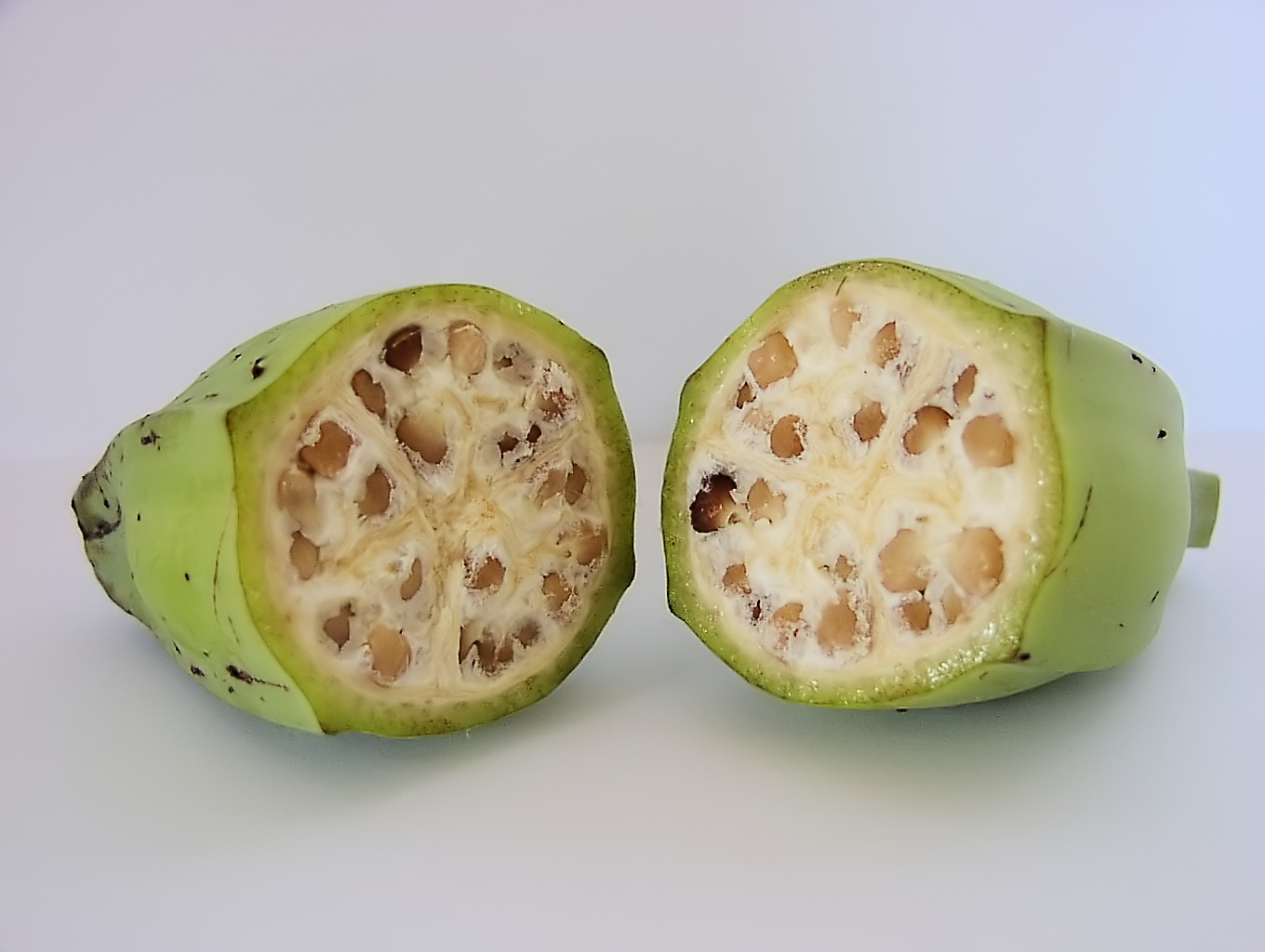
Did you know? The banana we normally eat are sterile and have no seeds. There are approximately a thousand species of bananas, most inedible. Botonists hypothesize that about 10,000 years ago, probably in South-East Asia, some random mutation gave rise to a sterile banana with no seeds and plump flesh that could be eaten raw.

Wild bananas.

The sterile banana plants grown in plantations are reproduced by cuttings from an existing banana plant. The life cycle starts with a large underground stem that can bud several banana plants. Each bud pushes up a shoot of leaves, tightly wrapped so that it looks like a green tree trunk; however, the banana plant is technically not a tree. At a certain time, the underground stem will switch from making leaves to an inflorescence, which is a cluster of flowers. Flowers become fruits and we get a hand of bananas. So each underground stem produces several banana plants, which in turn produces several hands of 10-20 bananas each. After fruiting, that bud and plant will die, and the cycle continues the next summer, when new buds appear on the underground stem once more.

Since the edible banana species are reproduced by cuttings, i.e. asexually, there is little or no genetic variation, and a disease or lethal mutation could potentially wipe out the entire crop.

Another bit of information: the edible bananas we are familiar with arise because of a trisomy. What does this mean? Most organisms have two sets of chromosomes (one from each parent). Monosomy occurs if a chromosome is missing, and a trisomy refers to the presence of three sets of chromosomes. For instance, the presence of an extra chromosome 21, which results in Down syndrome, is called trisomy 21. When an organism is a trisomy, it also becomes sterile, and in the case of a fruit like a banana, it will not produce seeds. Incidentally, this is also how seedless grapes come about.

The take-home message: even though the banana is rather phallic in shape, it is actually a sterile and mutant fruit that has not had sex in the past 10,000 years.

ReNe: osore-zan [june 2005]


The picture above was not taken at a beach, in fact, it is nowhere near an ocean or even at ground level.

It was taken at Osore-zan (恐山), a sacred volcano in Aomori, Japan. According to Japanese tradition, Osore-zan, a barren volcanic wasteland, is the gateway to hell. Making the trip there can be quite a hassle (the transfer of trains and buses alone will take up half a day), but the entire experience and destination are well worth it.

The lake in the picture above is Lake Usoriyama (宇曽利山湖), a caldera lake or volcanic crater lake. The white sandy beach might look inviting in the picture, but the water is actually full of sulfur and other mineral deposits, and is far too poisonous to sustain any life. The heavy miasma of sulfur dioxide hangs in the air, and the atmosphere of the place is sombre and poignant. This is where the Japanese come to pray for their dead, especially their dead children.


All around the barren landscape of Osore-zan, there are jizo statues; Jizo is the patron saint for dead children. Bibs and head-scarves adorn the statues, and colorful plastic windmills spin in the wind. These simple toys were left for the spirits of the dead children.

The entrance to Osore-zan.

Jizo statues.

Directions: Take the JR train to Hachinohe (a major station; the shinkansen stops there) and change onto a Limited Express train to Noheji (30mins). Then change to the JR Ominato line to Shimokita station (1hr), and then again to the Shimokita-Kotsu line until Tanabu (7mins). Alternatively, if you start from Aomori, there are direct trains to Shimokita station (90mins). Tanabu station is located in the town of Mutsu; once in Mutsu, there are hourly buses to Osore-zan (1hr). That's a lot of transfers, but the trains pass through parts of Aomori that are quite rustically scenic. Note that about 45mins into the bus journey, which is even more scenic as the bus wends its way along the lush mountainous region, the bus will stop for passengers to rinse their hands and mouth. Before entering a temple or sacred area, you're suppose to do cleanse yourself, but there is no fresh water at the top of Osore-zan so this would have to suffice.

The trains will get progressively smaller and slower as you transfer until you end up riding just one carriage.